← Back

HiKEY

Hierarchical Multimodal Retrieval
for Open-Domain Document Question Answering

Joongmin Shin1, Gyuho Shim3, Jeongbae Park1, Jaehyung Seo2‡, Heuiseok Lim1,3‡
1Human-inspired AI Research, Korea University   2CSE, Konkuk University   3CSE, Korea University
Corresponding authors
ACL 2026
HiKEY system architecture

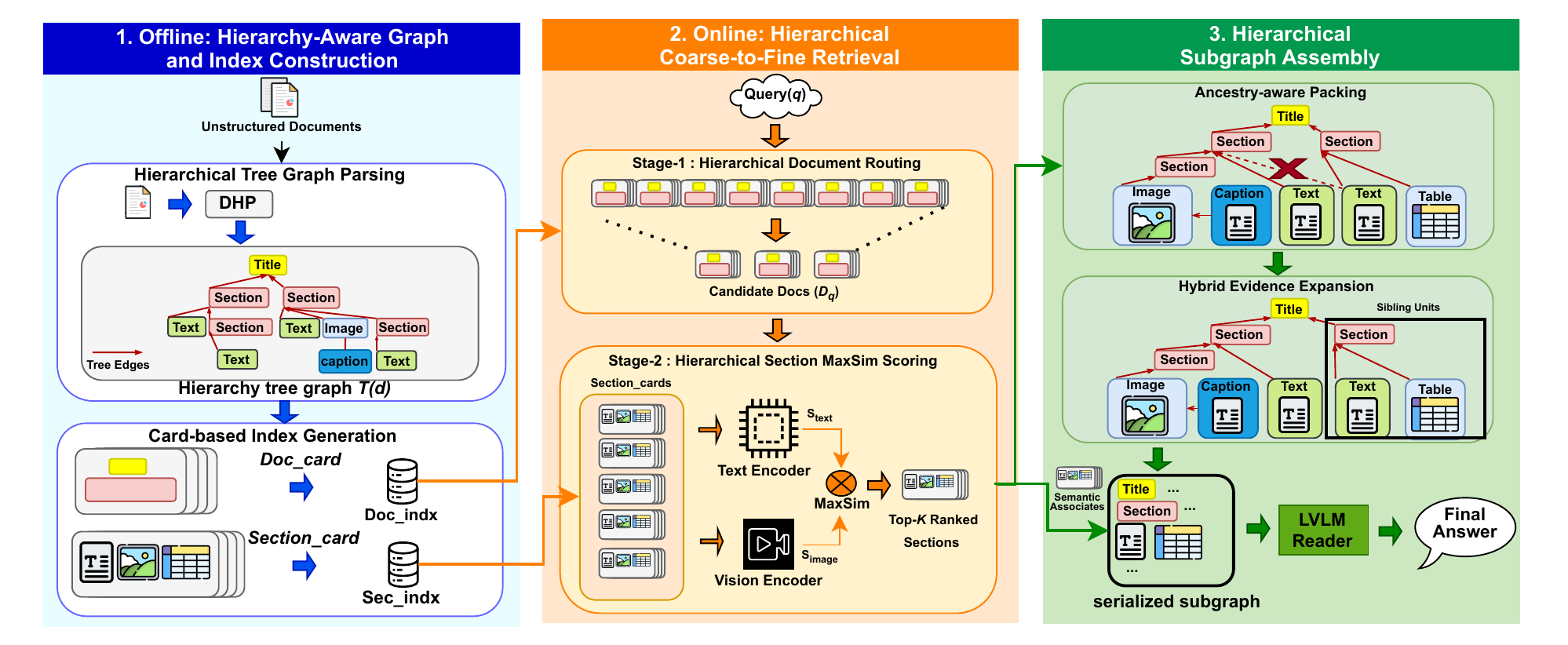
Figure 1. Overview of HiKEY. (1) Offline hierarchy-aware graph and index construction: each PDF is parsed into a DHP tree whose nodes (text/table/figure blocks) carry section-path metadata, then encoded into Doc_cards (global routing) and Sec_cards (fine retrieval). (2) Online hierarchical coarse-to-fine retrieval: Stage-1 prunes the corpus by Doc_card hybrid scoring; Stage-2 ranks sections via MaxSim over modality-specialized unit scores. (3) Ancestry-aware evidence subgraph assembly serializes the Anchor Unit with its Governing Headers plus sibling/semantic associates under a fixed token budget, then hands the subgraph to an LVLM reader.

Abstract

Retrieval-augmented generation (RAG) for document-based Open-domain Question Answering (ODQA) on large-scale industrial corpora faces two critical bottlenecks: routing failure in locating the correct document and evidence fragmentation in integrating scattered information. Existing approaches relying on flat text chunks or page-level images inherently struggle to (i) precisely pinpoint the target document among thousands of candidates and (ii) organically connect multimodal evidence — such as tables and figures — within a limited token budget.

We propose HiKEY, a hierarchical tree-based multimodal retrieval framework that elevates document hierarchy to a first-class retrieval signal. Instead of simple chunking, HiKEY reconstructs a logical heterogeneous graph via Document Hierarchical Parsing (DHP), explicitly encoding parent–child relationships. Adopting a hierarchical coarse-to-fine strategy, the framework (1) performs global routing to rapidly prune the search space using hierarchical indexing, and (2) conducts fine-grained retrieval to rank sections by employing a multimodal fusion strategy that captures the most discriminative evidence. Finally, HiKEY assembles a token-efficient evidence subgraph via a hybrid structural-semantic packing strategy.

Experiments on ODQA benchmarks demonstrate that HiKEY significantly outperforms page- and chunk-based baselines, improving retrieval recall by up to +12.9% and end-to-end QA performance by up to +6.8%.

Contributions

1
HiKEY framework. A hierarchical tree-based multimodal retrieval framework that elevates document hierarchy from passive metadata to a first-class retrieval signal. By reconstructing a logical graph via DHP, HiKEY structurally resolves the evidence fragmentation problem inherent in industrial documents — bridging the gap between flat retrieval and complex document layouts.
2
Hierarchical coarse-to-fine retrieval. A retrieval strategy that integrates global routing with local fine-grained ranking. A fine-grained multimodal fusion strategy identifies the most discriminative evidence within a section, coupled with a graph traversal mechanism that enriches visual units with their hierarchical upper context — ensuring robustness against visual ambiguity and missing captions.
3
Comprehensive experiments. Across industrial-aligned multi-page document ODQA benchmarks, HiKEY consistently outperforms state-of-the-art text-based and multimodal RAG baselines. Retrieval improves by 4.5%–12.9% and QA by 3.7%–6.8%, validating the efficacy of ancestry-aware subgraph assembly in token-limited settings.

Headline results

Improvement over the strongest chunk- / page-based baseline (MultiDocFusion · SimpleDoc).

+12.9%
peak retrieval recall gain
FRAMES strict All, MultiDocFusion → HiKEY (+11.4)
+6.8%
peak end-to-end QA gain
FRAMES ROUGE-L, MultiDocFusion → HiKEY
+4.5%
R@10 lift at 0.5K-token budget
where page-level methods can no longer fit

Method

HiKEY treats retrieval as a hierarchy-aware problem. Before retrieving, every document is rebuilt as a heterogeneous tree of multimodal blocks; at query time, the corpus is explored coarse-to-fine and a token-budgeted evidence subgraph is handed to the reader. The pipeline has four phases:

(a) Offline: Hierarchical Tree Graph Parsing

Each document d is processed by a Document Hierarchical Parsing (DHP) module — the M3DocDep parser trained on public hierarchy datasets — which produces a logical tree T(d) from page-level layout blocks. Every block (text, table, figure) becomes a node connected by parent–child tree edges Etree and receives an ancestor section path (e.g. Title › §5 › §5.3). For visual units lacking captions, a tree traversal pulls the nearest preceding textual node as Upper Context ctx(c), reducing visual ambiguity.

(b) Offline: Card-based Index Generation

HiKEY emits two hierarchical card types per document. A Doc_cardxd = Title(d) ∥ ⋃s∈T(d) path(s) — concatenates the document title with all section paths into a separate hierarchy field used for global routing. A Sec_card stores each section's text and non-text units Cs = {c1, …, cn} as searchable items, with each unit tagged by its modality type τ(c) ∈ {Text, Table, Image}.

(c) Online: Stage-1 Hierarchical Document Routing

For a query q, HiKEY first narrows the search scope by ranking Doc_cards via a hybrid lexical + dense-text score:

Sdoc(d, q) = α · mm(slex(xd, q)) + (1−α) · mm(stext(xd, q))

with per-query min–max normalization mm(·). The separately-indexed hierarchy paths in xd turn the table-of-contents into a directly searchable signal — the lever that resolves routing failure.

(d) Online: Stage-2 Section MaxSim Scoring + Subgraph Assembly

Within the routed candidate set, each unit gets a type-specific score (hybrid text scoring for Text units; weighted vision + Upper-Context text scoring for Tables/Images). A section's relevance is the MaxSim over its units, and the final ranking fuses document and section scores. The top-Ksec sections are then packed into the reader's token budget Btok by inserting the Anchor Unit and its Governing Headers, then expanding with Sibling Units (same-subtree structural association) and Semantic Associates (high-similarity non-local units) — preserving logical coherence while capturing cross-section dependencies.

How a query flows through HiKEY

A worked example. The user asks a multi-hop, table-grounded question against a corpus of multi-page PDFs. We trace what each stage sees and emits.

Input query. A multi-hop question whose answer is split across two PDFs and partially lives in a table cell.

q: "In the Apollo 11 mission, who was the command-module pilot, and what was the lunar-module's payload mass at landing?"
Evidence type: Text + Table · Hops: 2 documents

Hierarchical document routing. Doc_cards index title + section paths in a separate hierarchy field. HiKEY scores every Doc_card with a lexical + dense-text hybrid, normalizes per query, and returns a candidate set q — typically a handful of docs out of thousands.

Sdoc(d, q) = α · mm(slex) + (1−α) · mm(stext)
q: apollo_11_mission.pdf · lunar_module_eagle.pdf · apollo_crew_bios.pdf
Field-separated hierarchy lifts Avg R@10 from 84.6 → 88.6 vs. concatenation.

Section MaxSim with type-specific scoring. Inside each candidate doc, every unit is scored under its modality. Tables/Images additionally use the Upper-Context text signal (the closest textual ancestor in the DHP tree) — fixing the case where a figure has no caption.

Ssec(s, q) = maxc ∈ Cs s(c, q)
Top sections:
apollo_crew_bios.pdf › Crew › Command Module Pilot  (Text anchor)
lunar_module_eagle.pdf › Specifications › Mass & Payload  (Table anchor + Upper Context)

Ancestry-aware subgraph. HiKEY packs the Anchor Unit + its Governing Headers, then fills the remaining budget with Sibling Units (same parent section) and Semantic Associates (high-similarity non-local units). The reader (LVLM) sees a token-efficient subgraph with the hierarchy intact.

Subgraph (≤ 0.5K tokens):
# Apollo 11 › ## Crew › ### Command Module Pilot
  Anchor: "Michael Collins served as the command module pilot…"
# Lunar Module Eagle › ## Specifications › ### Mass & Payload
  Anchor (Table): [landing mass row · descent-stage payload]
  Sibling: [propellant table — same parent §Specifications]
Budget-aware: HiKEY stays best even at 0.5K, where page-level methods cannot fit at all.

Schematic walkthrough; reproduces the running example from the paper's appendix.

Try it: Compare what each baseline retrieves

Reproduced from the paper's Apppendix G qualitative walkthrough and the three documented baseline failure modes (Appendix H, F1–F3). For the same Apollo 11 query, each baseline family produces its own evidence — switch baselines to see exactly how HiKEY's ancestry-aware subgraph differs.

Query

"Who were the crew members of Apollo 11, and when did they land on the Moon?"

Evidence: Text + Table · Sections: §3.1 Prime crew (crew) + §5.1 Landing (landing time)

Select a baseline family
Baseline

Chunk-RAG (LumberChunker)

Flat text chunks, no hierarchy field, corpus-wide similarity.

HiKEY (ours)

Ancestry-aware evidence subgraph

Anchor + Governing Headers, Sibling expansion within §3.1, Semantic Associate from §5.1 — packed under Btok.

Result: Both answer-bearing units arrive in one budget-aware subgraph — crew table (Sibling) and landing-time table (Semantic Associate) — each tagged with its own section path so the LVLM never confuses scope.

HiKEY's subgraph reproduces the exact serialized prompt from Appendix G.2; baseline behaviors track the failure modes documented in Appendix H.

Results

Evaluated on two industrial-aligned ODQA benchmarks — M3DocVQA (multi-page mixed-modality QA) and FRAMES-PDF (re-rendered multi-document multi-hop QA) — under a fixed Qwen2.5-VL-7B reader with a 16K token budget.

Document-level retrieval — averaged over K = 1…10 (%)

M3DocVQA FRAMES AVG
RecallAll RecallAll RecallAll
Text chunk-based RAG
Page80.666.465.434.473.050.4
LumberChunker81.568.164.833.273.250.6
MultiDocFusion83.070.566.234.874.652.6
Text-based GraphRAG
RAPTOR81.868.464.933.373.450.9
HopRAG82.369.365.834.274.151.8
Page-level multimodal RAG
M3DocRAG75.661.456.825.066.243.2
VDocRAG77.163.258.526.567.844.9
Multimodal GraphRAG
MoLoRAG76.062.057.425.566.743.8
SimpleDoc77.363.660.628.469.046.0
HiKEY (ours) 84.973.6 73.346.2 79.159.9

Largest gains under the strict All metric on FRAMES (+11.4 vs. MultiDocFusion) — where every supporting document must be retrieved.

End-to-end QA — ANLS / ROUGE-L (%)

M3DocVQA FRAMES
ANLSROUGE-L ANLSROUGE-L
LumberChunker24.225.69.412.5
MultiDocFusion25.927.310.813.9
HopRAG25.727.110.713.8
M3DocRAG27.028.25.99.0
VDocRAG27.428.86.39.4
MoLoRAG28.230.06.59.6
SimpleDoc28.730.16.89.9
HiKEY (ours) 30.732.2 14.617.7

On FRAMES, HiKEY closes the gap that multimodal page-level methods open up vs. text — ROUGE-L +3.8 over MultiDocFusion.

Token-budget sensitivity — R@10 (%)

Method 0.5K 1K 2K Avg
LumberChunker72.873.275.373.6
MultiDocFusion74.374.676.875.0
SimpleDoc (page)fixed — cannot resize69.0
HiKEY 78.879.181.379.5

HiKEY remains best at every budget — page-level units cannot dynamically resize.

Ablation — Avg R@10

Stage-1 · Hierarchy indexing
Body-only (no hierarchy) 81.2
+ Concat title/header 84.6
+ Field-separated (ours) 88.6
Stage-1 · Routing strategy
Sec-only routing 76.1
Doc-only routing 87.7
Doc → Sec coarse-to-fine (ours) 88.6
Stage-2 · Fusion signals
BM25 only 87.6
+ Text dense 88.2
+ Visual dense (full) 88.6

Why HiKEY beats every baseline family

Chunk-based text RAG. Weak document-level cues → field-separated hierarchy in Doc_card lifts Avg R@10 84.6 → 88.6.

Text-only GraphRAG. Tables/figures not first-class → Type-specific unit scoring + region-level visual embeddings (Table +2.9, Image +2.8 ANLS).

Page-level multimodal RAG. Whole-page units dilute evidence → block units + ancestry-aware packing; FRAMES strict All 34.8 → 46.2 (+11.4).

Multimodal page-graph GraphRAG. Connectivity without hierarchical scope → governing-headers + hybrid sibling/semantic expansion holds gains down to the 0.5K budget where page units no longer fit.

BibTeX

@article{shin2026hikey,
    title         = {HiKEY: Hierarchical Multimodal Retrieval for Open-Domain Document Question Answering},
    author        = {Shin, Joongmin and Shim, Gyuho and Park, Jeongbae and Seo, Jaehyung and Lim, Heuiseok},
    journal       = {arXiv preprint arXiv:2605.29606},
    year          = {2026},
    note          = {Accepted to ACL 2026 (Main)},
    url           = {https://arxiv.org/abs/2605.29606}
}